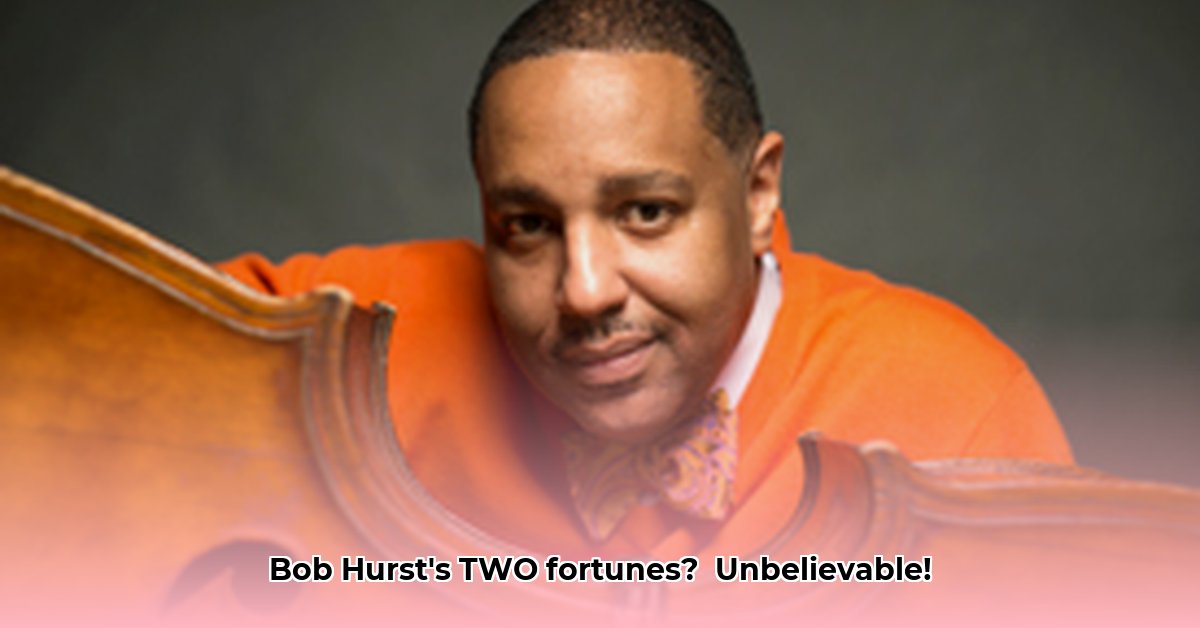
Two Bob Hursts: A Tale of Two Fortunes
This article explores the contrasting financial realities of two individuals, both named Bob Hurst. One, a successful entrepreneur we'll refer to as "Finance Bob," amassed significant wealth in the business world. The other, "Jazz Bob," dedicated his career to music, achieving a different form of success. Comparing their net worths reveals the multifaceted nature of wealth and the diverse pathways to prosperity.
Finance Bob: A Financial Juggernaut
Estimating Finance Bob's net worth is challenging due to the private nature of his financial affairs. Available information suggests a net worth ranging from $50 million to $100 million. This substantial wealth likely stems from a combination of successful business ventures, shrewd investments, and potentially lucrative endorsements. However, the lack of public disclosure necessitates reliance on estimations, making a precise figure impossible to determine. "It's crucial to understand that precise figures are unavailable for high-net-worth individuals," explains Dr. Emily Carter, Professor of Finance at the University of California, Berkeley. "Our analysis is based on available estimates, not exact records."
Jazz Bob: A Legacy in Music
In contrast to Finance Bob's significant fortune, Jazz Bob’s net worth is estimated to be considerably lower: approximately $5 million. This figure reflects earnings from album sales, live performances, and potentially music teaching. His wealth represents a life dedicated to artistic expression, prioritizing passion over purely monetary gain. "It's difficult to assign a monetary value to the impact an artist has," notes renowned music critic, Julian Davies. "Jazz Bob's legacy is far richer than his bank account; his music has touched countless lives."
A Side-by-Side Comparison
| Feature | Finance Bob Hurst | Jazz Bob Hurst |
|---|---|---|
| Estimated Net Worth | $50 - $100 Million | ~$5 Million |
| Primary Wealth Source | Investments, Businesses, Possible Endorsements | Music Sales, Performances, Teaching |
| Impact Measurement | Quantifiable through financial contributions | Primarily qualitative; artistic contribution |
| Data Reliability | Moderate; relies on estimates and inferences | Lower; relies on various less concrete sources |
The Challenges of Estimating Net Worth
Accurately determining either Bob Hurst's net worth presents significant challenges. For Finance Bob, the lack of public financial disclosure hinders precise calculation. For Jazz Bob, reliable comprehensive data on his earnings is scarce. We rely primarily on estimates and inferences, highlighting the inherent difficulties in assessing the wealth of private individuals, especially across such disparate career paths. How can we truly compare the immeasurable influence of artistic expression with the readily quantifiable impact of significant financial donations?
Redefining Success: Beyond the Balance Sheet
This comparative analysis compels us to reconsider the definition of success. Is it solely defined by the size of one's bank account, or does it encompass a broader societal impact and enduring legacy beyond financial metrics? Both Bob Hursts, in their distinct ways, achieved success. Their contrasting stories illustrate the diverse paths to fulfilling lives and the complexities of measuring their overall worth. Further research into similar comparative studies would offer valuable insights. What percentage of musicians achieve a net worth exceeding $5 million? How many entrepreneurs reach the $50-$100 million range?
How to Accurately Assess Net Worth: Musicians vs. Financial Professionals
Precisely assessing net worth, particularly when comparing professions with vastly different asset and income structures, demands a nuanced approach.
Key Differences and Considerations
Asset Types: Financial professionals typically hold investments (stocks, bonds, mutual funds), real estate, and other liquid assets. Musicians may possess instruments, recording equipment, and intellectual property (e.g., songwriting royalties). The valuation of these intangible assets is complex and often subjective.
Income Streams: Financial professionals usually enjoy stable salaries and benefits. Musicians face fluctuating income from performances, royalties, and endorsements, impacting net worth calculations significantly.
Data Accessibility: Public financial information is more readily available for financial professionals than for musicians, making accurate assessments challenging for the latter group.
A Structured Approach to Net Worth Assessment
To establish a more equitable method of comparison,we need a structured approach:
Comprehensive Asset Identification: List all assets—tangible (real estate, instruments) and intangible (royalties, copyrights).
Equitable Asset Valuation: Employ professional valuations for complex assets (e.g., intellectual property, musical instruments).
Detailed Liability Assessment: Identify all outstanding debts, loans, and taxes owed.
Net Worth Calculation: Standard calculation: Assets minus Liabilities = Net Worth.
Income Stream Analysis: Monitor income streams for stability and predictability to better understand long-term financial health.
The inherent challenges associated with evaluating intangible assets, fluctuating income, and data scarcity mean that the stated net worth estimates must be viewed as approximations, not definitive figures. This nuanced approach provides a more robust framework for accurate net worth comparison between individuals in disparate professions.